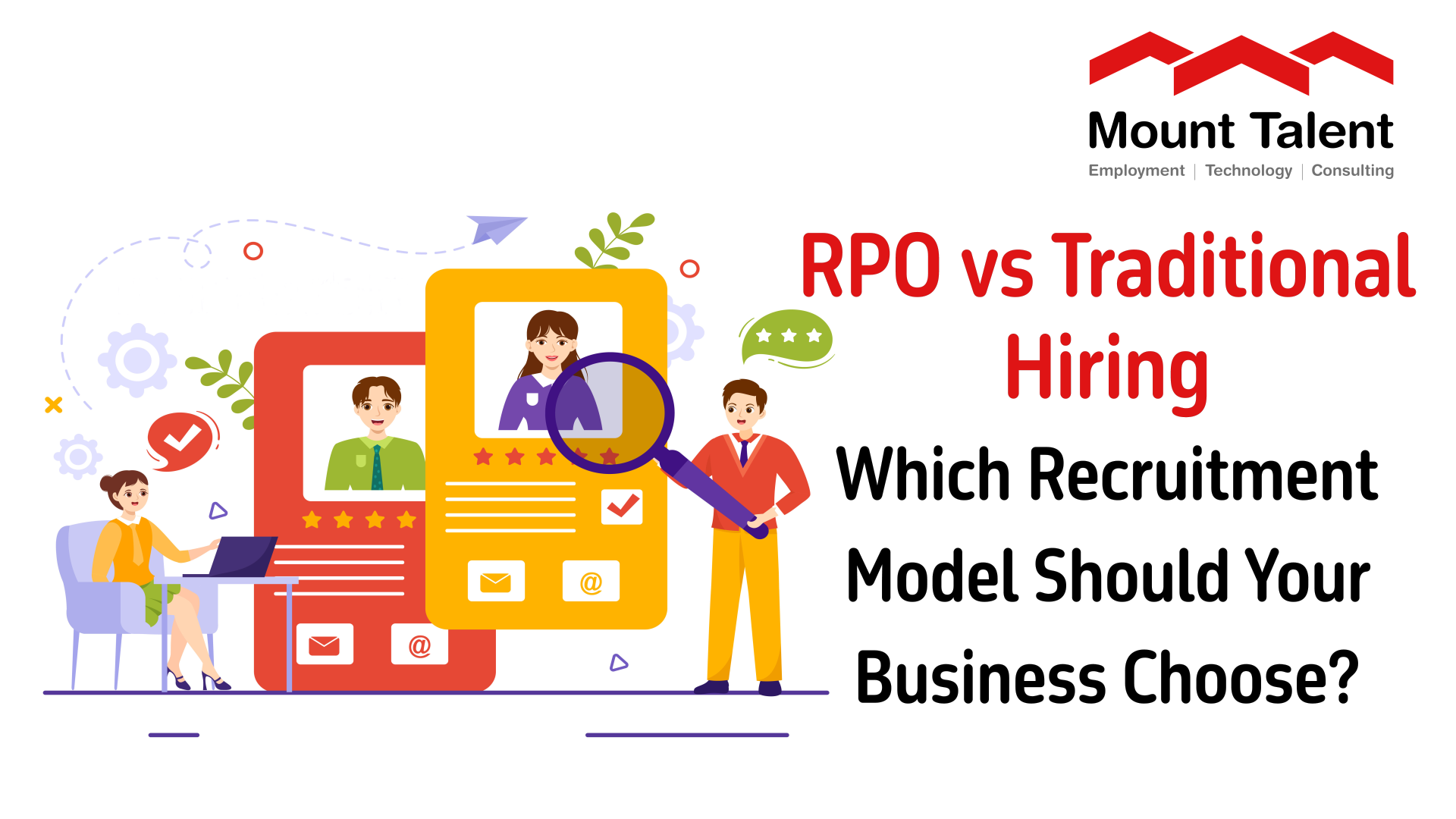
RPO vs Traditional Hiring: Which Recruitment Model Should Your Business Choose?
A comparison explaining benefits, cost savings, speed, and scalability.
If you handle hiring even occasionally, you already know how unpredictable it can become. One month everything is calm, and the next, your business suddenly needs 30 people across two cities and expects HR to do it “asap”. This is the point where most organisations pause and ask themselves whether they should continue with traditional hiring or explore RPO (Recruitment Process Outsourcing).
At Mount Talent Consulting, we’ve watched companies debate this for years. Sometimes they choose the familiar route because change feels unnecessary. Sometimes they explore RPO because they simply can’t afford long hiring delays. And honestly, both decisions can be right depending on the stage your company is in.
So instead of giving a textbook definition, here is a grounded, somewhat real-world view — the kind of comparison managers usually have in meeting rooms, scribbling on notepads while thinking through the situation.
What RPO Actually Means
RPO is basically like extending your HR team, except the additional help comes from specialists who do recruitment every single day. It’s not “outsourcing” in the old-fashioned way. It’s more like having a dedicated group of recruiters who understand your business, work on your roles, and follow processes that your internal team doesn’t always have time to set up.
And because it’s structured and accountability is clear you don’t feel the usual stress of chasing agencies or dealing with cold pipelines.
And Traditional Hiring? Well, It’s What Most Businesses Already Do
Your internal HR team posts jobs, screens CVs, calls candidates, manages interviews, handles negotiation, and everything in between. It works when hiring is stable and predictable. But it slows down the moment hiring demand picks up or when specialised roles appear.
Most HR teams simply don’t have the bandwidth to ramp up instantly. They aren’t designed for sudden surges.
Let’s Compare But In a Way That Feels Practical, Not Overly Polished
Speed of Hiring
RPO:
Dedicated recruiters – faster sourcing.
Clear SLAs – fewer delays.
Better tools – faster screening.
Traditional Hiring:
Speed varies depending on the HR team’s workload, which is rarely light. They manage employee issues, compliance, onboarding, and internal operations – recruitment isn’t their only responsibility.
Reality:
If hiring needs to be fast, RPO is almost always quicker. It’s simply designed for volume and pace.
Cost Savings
Businesses are often surprised when they realise how much traditional hiring actually costs — small amounts scattered across job boards, tools, agencies, extra hours, and delays that cause productivity loss.
RPO:
Costs become predictable. You don’t keep buying job postings or paying multiple agencies. Tools, dashboards, ATS systems — all included.
Traditional Hiring:
Variable, unpredictable, often higher than estimated. Especially when roles remain unfilled for long periods.
Reality:
RPO usually saves more cost. Not because it’s cheaper upfront, but because it eliminates hidden expenses.
Scalability
Some months you hire five people. Some months you need fifty.
RPO:
Scales instantly. The team can expand or shrink based on the requirement. No additional onboarding, no training, no new software.
Traditional Hiring:
Your HR team cannot multiply itself overnight. Even if they try, the process slows down because internal teams are not built for rapid scale.
Reality:
If your hiring demand is inconsistent (which is true for most businesses), RPO gives you breathing room.
Quality of Talent
People rarely discuss this openly, but quality often suffers when HR teams are overloaded.
RPO:
Strong sourcing capability, better screening, wider networks, and continuous pipelines.
Traditional Hiring:
Quality depends on how much time the HR team can spend per role. When they get stretched, screening becomes surface-level.
Reality:
RPO tends to be more consistent.
Technology & Tools
Let’s be honest – most internal teams don’t have access to the latest hiring tools unless the company invests heavily.
RPO:
Comes with ATS systems, sourcing platforms, analytics dashboards — tools that could cost a lot if purchased individually.
Traditional Hiring:
Emails, spreadsheets, job boards. Works fine, but not built for speed or scale.
Reality:
RPO almost always has a tech advantage.
Which One Should Your Business Choose?
This question sounds simple but isn’t. It depends on where your business is today, not where it was two years ago.
Choose RPO if:
- hiring fluctuates through the year
- your HR team feels stretched
- open roles remain unfilled for too long
- you want measurable hiring performance
- speed matters
- your organisation is expanding to new locations
Choose Traditional Hiring if:
- hiring is slow and stable
- the HR team has enough time
- you want full internal control
- roles are straightforward and limited in number
Most organisations eventually shift toward RPO when they grow, because recruitment complexity increases even if they don’t notice it internally.
Mount Talent Consulting often sees companies switch to RPO after one frustration-filled quarter usually a phase with delayed hiring or high dropouts.
Why Many Organisations Prefer Mount Talent Consulting’s RPO Approach
One reason clients choose RPO from Mount Talent Consulting is the clarity. There is a team, there is a structure, and there is an outcome. No ambiguity. No juggling between agencies. No starting-from-scratch every time you open a new role.
It also helps that the model is flexible. Some companies only outsource parts of the hiring process; others outsource the entire recruitment lifecycle. Both work it depends on what the business needs at that moment.
FAQs
1. Does RPO work for companies that hire seasonally or unpredictably?
Yes. In fact, RPO is specifically designed for businesses with fluctuating hiring volumes because it scales up or down quickly.
2. Is RPO more expensive than traditional hiring?
Not usually. Traditional hiring has many hidden costs. RPO offers structured pricing and often saves more in the long run.
3. How do we know if we’re ready to shift from traditional hiring to RPO?
If your HR team is overworked, hiring delays are frequent, or expansion is planned, it’s a strong sign that RPO will fit better.
A comparison explaining benefits, cost savings, speed, and scalability. If you handle hiring even occasionally, you already know how unpredictable…