
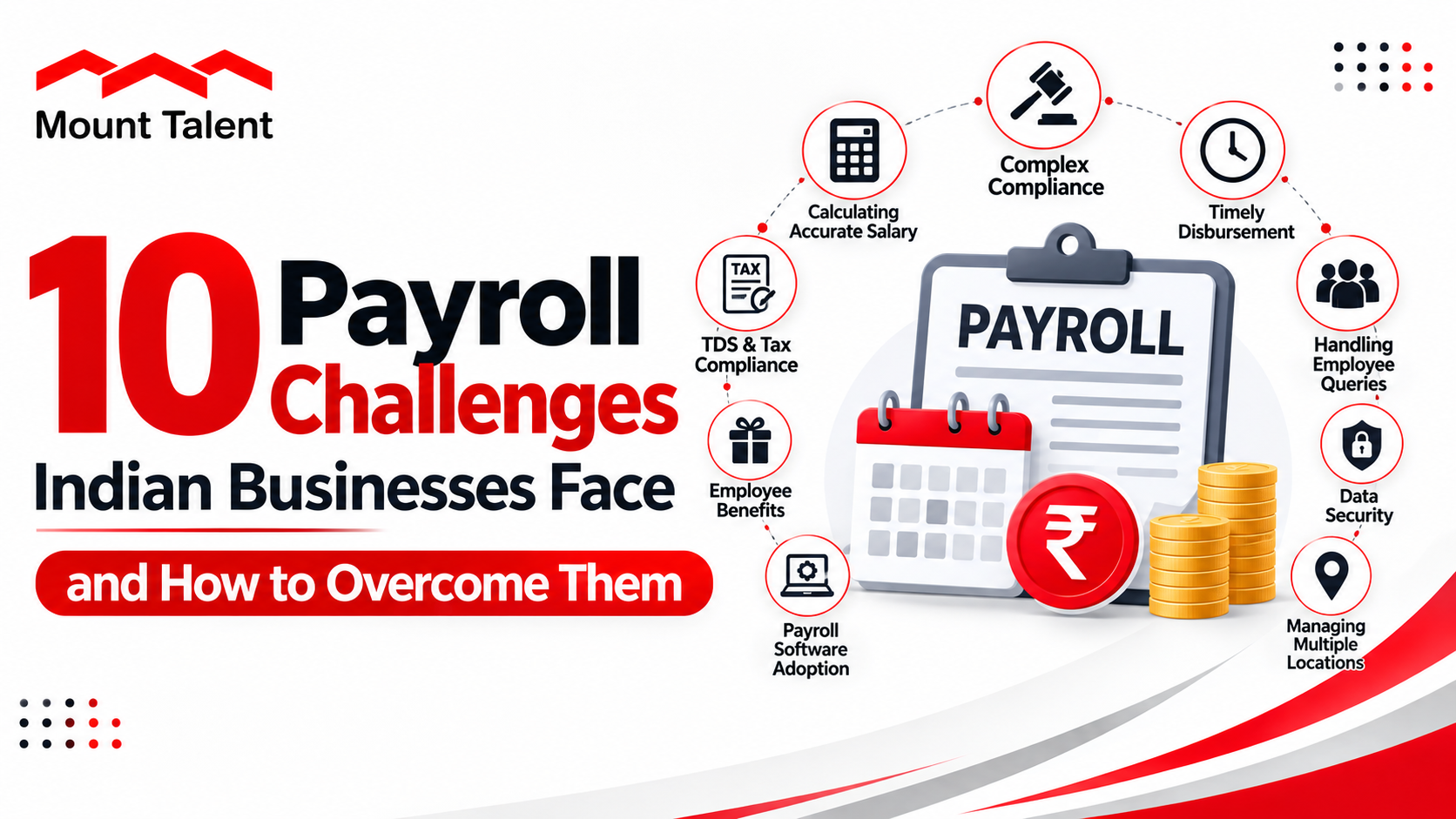
10 Payroll Challenges Indian Businesses Face and How to Overcome Them
10 Payroll Challenges Indian Businesses Face and How to Overcome Them
It is the last week of the month, and your HR or accounts team is already under pressure. Attendance needs to be verified, leaves adjusted, PF and ESI calculated, TDS checked and salary slips prepared. One wrong figure, and employees start calling. A delayed salary, and trust takes a hit.
Payroll looks simple from outside: pay people what they earn. In reality, it is one of the most complex and sensitive parts of running a business in India. Rules change, data is scattered, and mistakes directly affect people’s lives.
In this guide, you will learn the 10 most common payroll challenges Indian businesses face, along with practical ways to overcome each one, whether you manage 20 employees or 2,000.
Why Payroll Management Matters More Than You Think
Salary is the most visible promise a company makes to its people. Getting it right, on time, every time, builds trust and reduces stress. Getting it wrong leads to unhappy employees, penalties, legal trouble and sometimes resignations.
The cost of payroll mistakes
An error in deduction, a missed PF deposit or an incorrect tax calculation can mean notices from authorities, interest and penalties, and hours of rework. For employees, even a small mistake can feel like a lack of care. Strong payroll management protects both the business and its people.
10 Common Payroll Challenges and How to Overcome Them
1. Keeping up with changing compliance rules
India has many payroll-related laws, including PF, ESI, professional tax, labour welfare fund, gratuity and income tax rules. Rates, limits and due dates change, and some rules differ from state to state.
How to overcome it: Assign a person responsible for tracking compliance updates, use a compliance calendar and choose payroll software that updates statutory rules automatically. If you operate in multiple states, consider expert support for state-specific requirements.
2. Manual calculation errors
Many small and mid-sized businesses still use Excel sheets for salary processing. A broken formula or a copy-paste mistake can affect many employees at once.
How to overcome it: Move to payroll software that automates calculations, and until then, add a second-person review step before salaries are released. Always compare each month’s total payroll with the previous month to catch unusual jumps.
3. Inaccurate attendance and leave data
Payroll depends on attendance. If records are incomplete or disputed, salaries are wrong, and arguments follow.
How to overcome it: Use a digital attendance and leave system linked to payroll. Set a clear cut-off date for submitting leave and attendance corrections, and make sure managers approve records on time.
4. Delays in salary payments
Late salaries are one of the fastest ways to lose employee trust. Delays usually happen because of last-minute data changes, slow approvals or cash flow planning gaps.
How to overcome it: Create a fixed payroll calendar with deadlines for each step: data collection, verification, approval and payment. Share it with managers and finance teams so everyone knows their part.
5. Complex salary structures
Basic pay, HRA, special allowance, bonuses, incentives, reimbursements and variable pay can make salary structures confusing. Employees often struggle to understand their payslip.
How to overcome it: Keep the structure as simple and transparent as possible. Explain each component in an easy guide or during onboarding, and make sure payslips are clearly laid out.
6. Tax deduction and TDS complications
Calculating TDS on salary involves tax slabs, regime choices, investment declarations and proof submission. Mistakes can lead to employees paying extra tax or facing notices later.
How to overcome it: Collect investment declarations early in the year and proofs well before year-end. Remind employees about the tax regime options, and use software that calculates TDS correctly. When in doubt, consult a tax professional.
7. Managing multiple locations and shifts
Companies with branches in different states, or with shift workers, face varied rules for working hours, overtime, holidays and statutory contributions.
How to overcome it: Use a centralised payroll system with location-wise rules. Keep clear overtime and shift allowance policies, and review them regularly with local managers.
8. Handling contract workers and freelancers
Businesses now work with full-time staff, contract workers, interns and freelancers. Each type may have different payment terms, tax treatment and compliance requirements.
How to overcome it: Define worker categories clearly in contracts and treat them correctly under the law. Keep separate processes for employees and independent professionals, and consult a legal or tax expert if you are unsure about classification.
9. Data security and privacy risks
Payroll data includes bank details, PAN numbers, salary figures and personal information. A leak can seriously damage trust and may lead to legal trouble.
How to overcome it: Limit access to payroll data to authorised people only, use password protection and two-step verification, and avoid sharing salary files through personal email or messaging apps. Choose payroll tools with strong security practices.
10. Poor employee communication and query handling
Employees often ask: “Why is my salary less this month?” “Where is my Form 16?” “Why was this amount deducted?” Answering these one by one takes up a lot of HR time.
How to overcome it: Offer an employee self-service portal or app where people can see payslips, tax details and leave balances. Share a short explainer whenever there is a change in structure, and set a clear process for raising payroll queries.
Best Practices for Smooth Payroll Processing
Beyond solving individual challenges, a few habits keep payroll healthy over time.
Build a monthly payroll checklist
List every step, from attendance lock to bank transfer, and tick them off each month. A checklist reduces the chance of forgetting something under pressure.
Reconcile and audit regularly
Compare payroll records with bank statements, statutory challans and previous months. Quarterly internal audits help you catch small issues early.
Keep documentation ready
Maintain records of salary registers, challans, returns and employee declarations. Well-organised documents make audits and inspections far easier.
Train your payroll team
Payroll staff should understand both the software and the underlying laws. Short regular training sessions on updates keep their knowledge fresh.
Communicate changes early
If a policy, tax rule or deduction is changing, inform employees before the payroll run, not after the complaints.
When Should You Consider Payroll Software or Outsourcing?
If your team spends several days every month on payroll, makes frequent errors or struggles with compliance, it may be time for a change.
- Payroll software suits businesses that want control in-house but need accuracy, automation and reports.
- Payroll outsourcing suits businesses that prefer experts to handle processing and compliance, especially when the HR team is small.
Whichever you choose, check that the provider supports Indian statutory rules, offers good data security, and provides reliable customer support.
Common Mistakes to Avoid
- Ignoring small errors. Minor mistakes repeat every month and grow into big problems.
- Skipping reviews before payment. A quick check can prevent hours of correction later.
- Choosing a tool only for its low price. Weak compliance support can cost far more in penalties.
- Not backing up data. Keep secure copies of payroll records.
- Failing to explain changes to employees. Surprises in payslips create distrust.
Frequently Asked Questions
What are the most common payroll challenges in India?
The most common payroll challenges in India include changing compliance rules, manual errors, wrong attendance data, delayed salaries, TDS complications and data security risks.
How can a company avoid payroll errors?
A company can avoid payroll errors by using payroll software, verifying attendance data before processing, adding a review step and comparing each month’s figures with the previous month.
Do small businesses need payroll software in India?
Yes, even small businesses benefit from payroll software because it automates calculations, reduces mistakes and helps manage PF, ESI and TDS compliance with less effort.
Conclusion
Payroll is more than numbers. It is about accuracy, trust and compliance. By understanding common challenges and fixing them step by step, Indian businesses can pay employees correctly and on time while staying on the right side of the law. Start with one weak spot, such as attendance data or compliance tracking, and improve from there. If you are hiring payroll or HR professionals, or searching for your next role, explore current openings on Rojgar.com, and check official provident fund updates at EPFO.
10 Payroll Challenges Indian Businesses Face and How to Overcome Them It is the last week of the month, and…