
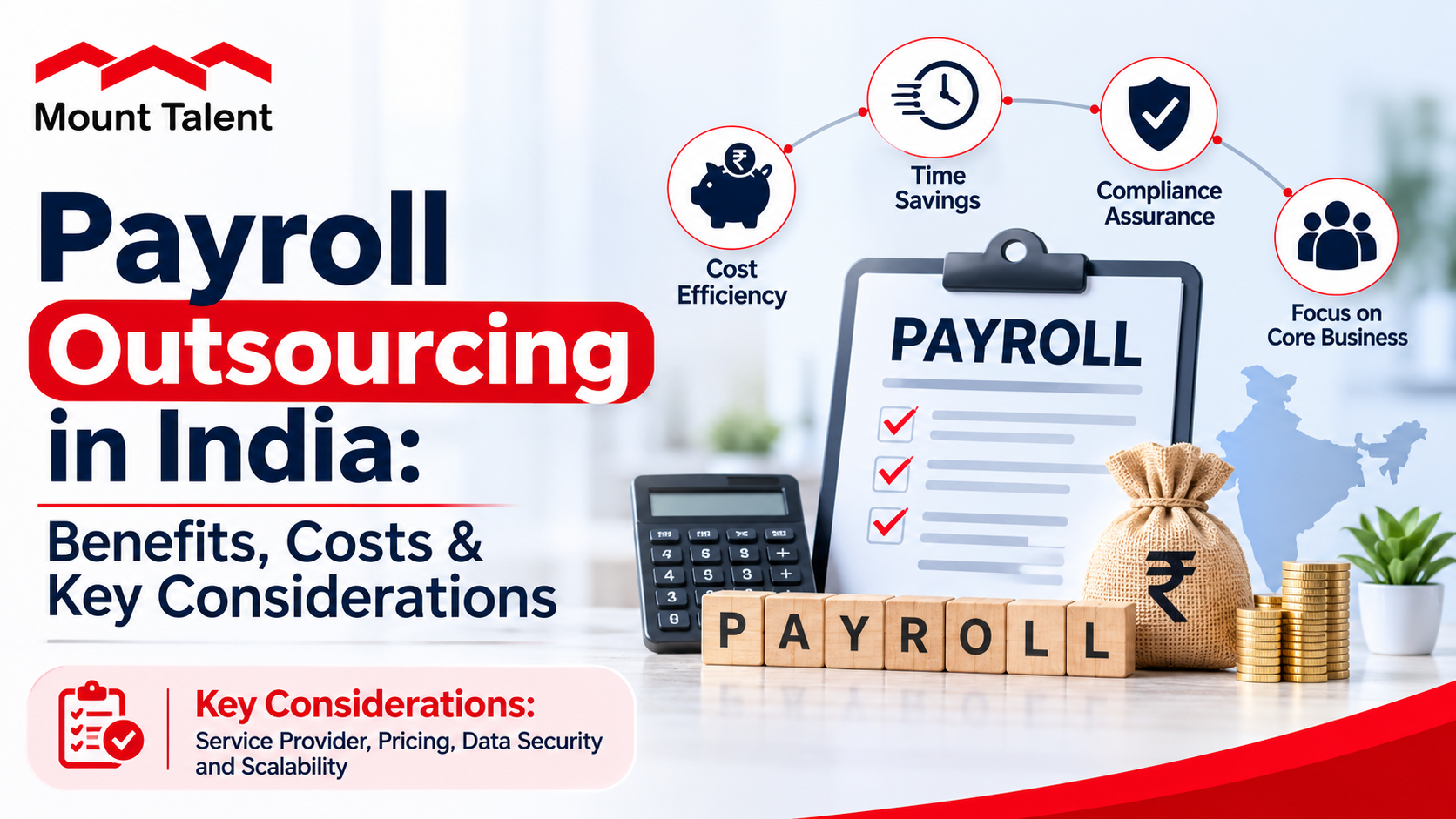
Payroll Outsourcing in India: Benefits, Costs & Key Considerations
Payroll Outsourcing in India: Benefits, Costs & Key Considerations
Every month, the same cycle begins. Attendance data arrives late, someone finds a wrong deduction, a PF challan is due in two days, and employees are already asking about salary. For many small and mid-sized Indian businesses, payroll takes up far more time and stress than it should.
That is why more companies are asking a simple question: should we hand payroll to an expert? Payroll outsourcing is one answer, but it is not right for everyone, and the wrong choice can create new problems.
In this guide, you will learn what payroll outsourcing means, its benefits, how pricing usually works in India, the risks to watch for and how to choose a provider you can trust.
What Is Payroll Outsourcing?
Payroll outsourcing means hiring an external service provider to handle salary processing, statutory compliance, payslips and related reports on behalf of your company. You still decide who gets paid and how much, but the provider does the calculations, filings and record-keeping.
What a payroll provider usually handles
- Salary calculation and payslip generation
- PF, ESI, professional tax and labour welfare fund calculations and filings
- TDS on salary, Form 16 and tax reports
- Leave, attendance and overtime integration
- Reimbursements, bonuses and full and final settlements
- Payroll reports and statutory registers
- Employee queries on payslips (in some plans)
Outsourcing vs in-house payroll vs payroll software
In-house payroll means your team does everything, often with Excel. Payroll software automates the work but your team still runs it. Outsourcing moves the processing itself to a third party. Many providers also offer a mix, such as software plus managed support.
Benefits of Payroll Outsourcing in India
Better compliance
India has many payroll laws that change often and vary by state. Specialist providers track these updates daily, which lowers the risk of missed deadlines and penalties.
Fewer errors
Professional teams and tested systems reduce calculation mistakes, which means fewer employee complaints and less rework.
Saves time for your HR team
When payroll no longer consumes several days each month, HR can focus on hiring, engagement and training.
Cost savings for small and growing companies
Hiring a full-time payroll specialist, buying software and keeping up with training can cost more than a monthly service fee, especially for teams under a few hundred employees.
Data security and confidentiality
Reputed providers use secure systems, access controls and backups. This can be safer than salary files sitting in personal laptops and email inboxes.
Scalability
When you hire quickly or open new locations, an outsourced provider can scale up without you building a bigger team.
Better employee experience
On-time salaries, clear payslips and easy access to tax documents improve trust and satisfaction.
How Much Does Payroll Outsourcing Cost in India?
Pricing varies widely by provider, company size and services included, so treat any figure as a starting point and always request written quotes.
Common pricing models
- Per employee per month: The most common model. Smaller companies often see lower per-employee rates from basic providers, while full-service plans cost more.
- Fixed monthly fee: Useful for companies with stable headcount.
- Tiered or slab pricing: Rates change with the number of employees.
- Add-on charges: Extra fees for compliance filings, Form 16, full and final settlements or multi-state setups.
Factors that affect the cost
- Number of employees and number of states
- Complexity of salary structures
- Whether compliance filings are included
- Level of support, such as a dedicated manager
- Integration with attendance or accounting systems
- Software access, mobile apps and self-service portals
Hidden costs to ask about
Ask about setup fees, charges for corrections, fees for off-cycle payroll, data migration costs and what happens if you need to exit. A low headline price can become expensive once add-ons appear.
Risks and Drawbacks to Consider
Outsourcing is helpful, but it is not risk free.
- Less direct control. You depend on the provider’s timelines and processes.
- Data privacy concerns. You are sharing sensitive employee information, so security practices matter.
- Communication gaps. Delays in sharing inputs or answering queries can cause errors.
- Provider quality varies. Some providers lack real expertise in state-specific compliance.
- Switching can be hard. Moving to another provider later takes effort, so a careful choice upfront matters.
Your company remains responsible under the law, even when a vendor handles the work. Outsourcing shares the workload, not the accountability.
Key Considerations Before You Outsource Payroll
Check Indian compliance expertise
Ask how the provider handles PF, ESI, professional tax, labour welfare fund, TDS and state-wise rules, especially if you operate in several states.
Review security and data protection
Ask about data encryption, access controls, backup practices and how they handle confidentiality. Request their data protection policy in writing.
Look at technology and integration
Check whether their system works with your attendance, HRMS or accounting tools, and whether employees get an easy mobile or web portal.
Understand service levels
Get clear commitments on deadlines, error correction timelines and query response times. A written service level agreement protects you.
Ask for references
Speak to companies of your size and industry that use the provider. Their honest feedback is more useful than any brochure.
Review the contract carefully
Look at contract length, price revision terms, exit clauses, data return after termination and liability for errors or penalties.
Start with a pilot or parallel run
Where possible, run the provider’s payroll alongside your own for one or two cycles before fully switching. This helps catch problems early.
How to Outsource Payroll Step by Step
- List your needs. Note employee count, locations, salary components and compliance requirements.
- Shortlist providers. Compare three to five options based on experience, reviews and services.
- Request demos and quotes. Ask for full, itemised pricing.
- Check references and security. Verify their claims.
- Prepare your data. Clean employee records, salary structures and bank details before migration.
- Run a trial cycle. Compare outputs with your existing numbers.
- Go live and review. Check accuracy and timeliness in the first few months and give feedback.
When Does Payroll Outsourcing Make Sense?
Outsourcing is a good fit if:
- Your payroll team is small or non-existent
- You struggle with compliance across multiple states
- Payroll errors or delays happen often
- You are growing fast and need to scale
- HR time is being drained by manual work
It may not be ideal if you have a very small team with simple salary structures, where basic payroll software could be enough, or if you want complete in-house control over sensitive data.
Common Mistakes to Avoid
- Choosing only on price. The cheapest option may lack compliance depth or good support.
- Skipping contract details. Unclear terms cause disputes later.
- Handing over messy data. Errors in your records will carry into the new system.
- Assuming the vendor handles everything. Your company still has to approve inputs and verify outputs.
- Not informing employees. Explain the change early so staff know where to send queries.
Frequently Asked Questions
What is payroll outsourcing in simple words?
Payroll outsourcing means paying an outside company to handle salary calculation, statutory compliance, payslips and payroll reports for your business.
How much does payroll outsourcing cost in India?
The cost depends on employee count, services and provider, and is usually charged per employee per month or as a fixed fee, so always compare itemised written quotes.
Is payroll outsourcing safe for small businesses?
Yes, it can be safe when you choose a provider with strong data security, clear contracts and proven Indian compliance experience.
Conclusion
Payroll outsourcing can save time, reduce errors and keep your business compliant, but only when you choose the right partner and stay involved in the process. Compare providers carefully, read the contract closely and start with a trial cycle. If you are hiring payroll or HR professionals, or looking for your next role, explore current openings on Rojgar.com, and read official labour law updates at the Ministry of Labour & Employment.
Payroll Outsourcing in India: Benefits, Costs & Key Considerations Every month, the same cycle begins. Attendance data arrives late, someone…