
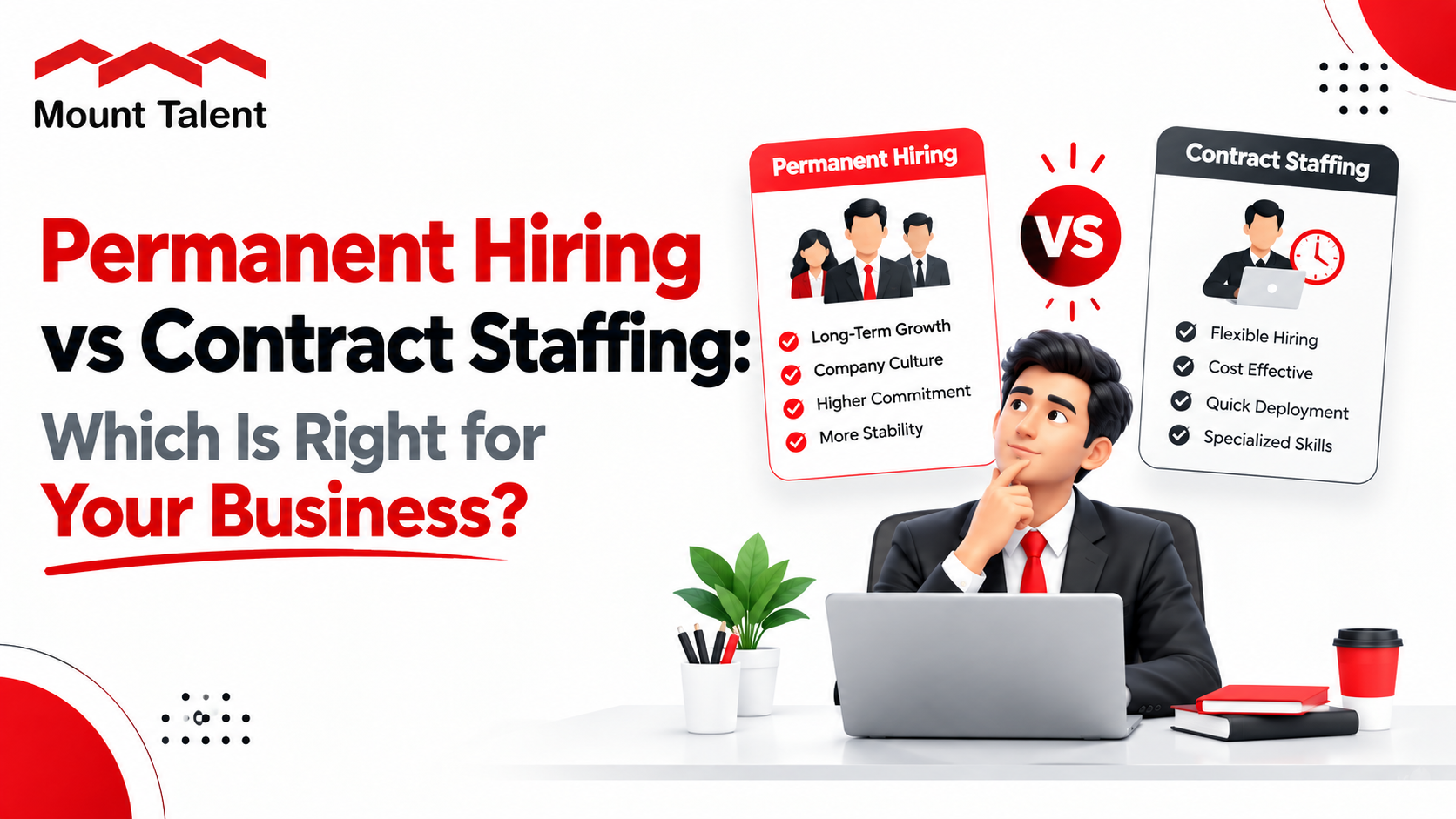
Permanent Hiring vs Contract Staffing: Which Is Right for Your Business?
Permanent Hiring vs Contract Staffing: Which Is Right for Your Business?
Every growing business eventually faces the same question: should this role be filled with a permanent employee, or does contract staffing make more sense? It’s a decision that affects your budget, your flexibility, and how quickly you can respond to changing business needs. Get it wrong, and you either end up overstaffed with fixed costs during a slow quarter, or scrambling to fill a critical long-term role with short-term help.
In this guide, we’ll break down permanent hiring and contract staffing in plain terms, compare their real advantages and trade-offs, and help you figure out which approach — or combination of both — makes the most sense for your specific business situation in India today.
Understanding Permanent Hiring
Permanent hiring refers to bringing an employee onto your company’s payroll on an indefinite basis, with standard benefits, job security, and long-term commitment from both sides.
Key Characteristics of Permanent Employment
Permanent employees typically receive full statutory benefits, including provident fund contributions, gratuity, health insurance, and paid leave, along with a structured career path within the organization. This model builds long-term loyalty and deeper institutional knowledge over time.
When Permanent Hiring Makes the Most Sense
- Core business functions: Roles central to your company’s long-term strategy and operations
- Leadership positions: Management and senior roles that require deep organizational understanding and continuity
- Client-facing roles: Positions where relationship continuity directly affects business outcomes
Understanding Contract Staffing
Contract staffing involves hiring workers for a defined period or specific project, often through a staffing agency, without the long-term commitments associated with permanent employment.
Key Characteristics of Contract Staffing
Contract employees are typically engaged for a fixed duration, whether a few months or a couple of years, and may be employed directly by your company or through a third-party staffing partner who manages payroll and compliance on your behalf.
When Contract Staffing Makes the Most Sense
- Project-based work: Short-term initiatives with a clear start and end date
- Seasonal demand spikes: Roles needed only during peak business periods, such as festive season retail support
- Specialized short-term expertise: Niche skills needed temporarily, such as a specific technology migration project
Comparing Costs: Permanent Hiring vs Contract Staffing
Cost is often the deciding factor businesses focus on first, but the comparison is more nuanced than it initially appears.
Upfront and Ongoing Costs
Permanent hiring involves higher fixed costs, including statutory benefits, long-term salary commitments, and severance obligations if the relationship ends. Contract staffing often carries a higher hourly or monthly rate per worker but avoids many long-term financial commitments, making it more predictable for short-term budgeting.
Hidden Cost Considerations
Permanent hiring includes recruitment costs, onboarding investment, and training time that only pays off over a longer employment duration. Contract staffing reduces this risk since the engagement period is clearly defined upfront, but frequent turnover of contract workers can lead to repeated onboarding costs if not managed carefully.
Flexibility and Scalability Differences
How quickly and easily you can adjust your workforce size is a major differentiator between these two models.
Permanent Hiring and Long-Term Stability
Permanent employees provide workforce stability and are generally easier to retain for building institutional knowledge, but scaling down a permanent workforce during slow periods involves a more complex and often costly process.
Contract Staffing and Rapid Scaling
Contract staffing allows businesses to scale up or down quickly based on demand, without the same legal and financial complexity involved in permanent workforce reductions. This flexibility is particularly valuable for businesses with seasonal or project-based demand fluctuations.
Compliance and Legal Considerations in India
Both hiring models come with distinct compliance responsibilities that businesses need to understand clearly.
Permanent Employment Compliance
Permanent employees are covered under various labor laws, including provisions for provident fund, gratuity, and standard termination procedures, requiring businesses to maintain proper documentation and adherence to applicable state and central labor regulations.
Contract Staffing Compliance
Contract staffing arrangements, especially those managed through third-party staffing agencies, shift much of the compliance burden, including payroll processing and statutory contributions, to the staffing partner, though businesses should still verify that their staffing partner maintains full legal compliance.
Impact on Company Culture and Employee Engagement
The choice between these models also affects team dynamics and long-term organizational culture.
Building Culture With Permanent Teams
Permanent employees tend to develop deeper connections with company culture, values, and long-term goals, often leading to stronger collaboration and institutional knowledge retention over time.
Managing Culture With Contract Workers
Contract workers may feel less integrated into company culture due to the temporary nature of their engagement, so businesses should make deliberate efforts to include contract staff in relevant team activities and communications to maintain morale and productivity during their tenure.
How to Decide: A Practical Framework
Rather than choosing one model exclusively, most successful businesses use a thoughtful mix based on specific role requirements.
Questions to Ask Before Deciding
- Is this role central to long-term business strategy, or tied to a specific, time-bound project?
- Does the position require deep institutional knowledge that takes time to build?
- Can we predict staffing needs for this function over the next 12 to 24 months, or is demand highly variable?
- What compliance and administrative capacity do we currently have to manage each hiring model effectively?
Building a Hybrid Workforce Strategy
Many Indian companies now maintain a core team of permanent employees for critical functions while using contract staffing for project-based work, seasonal demand, or specialized short-term needs, giving them both stability and flexibility simultaneously.
Frequently Asked Questions
Is contract staffing cheaper than permanent hiring? Not always; contract staffing avoids long-term benefit costs but often carries higher rates per engagement, so the actual cost comparison depends on the role duration, benefit obligations, and turnover frequency involved.
Can contract employees be converted to permanent roles in India? Yes, many companies convert high-performing contract employees to permanent positions after evaluating their fit and performance over the contract period, which is a common practice across Indian industries.
Which model is better for startups in India? Startups often benefit from a hybrid approach, using contract staffing for flexible, project-based needs during early growth stages while reserving permanent hiring for core leadership and strategic roles central to long-term operations.
Conclusion
Choosing between permanent hiring and contract staffing isn’t about picking one model forever — it’s about matching the right hiring approach to each specific role based on cost, flexibility, compliance, and long-term business strategy, and most successful Indian companies today rely on a thoughtful blend of both. For more workforce strategies and the latest job opportunities across India, visit Rojgar.com
Permanent Hiring vs Contract Staffing: Which Is Right for Your Business? Every growing business eventually faces the same question: should…